
The Eiffel Tower at night
The Eiffel Tower opens daily from 09:30 (09:00 from late June to early September) with last ascents at 22:45. The golden illumination switches off at 23:45 and the final five-minute sparkle of the night begins at 23:00, visible from the Trocadéro, the Champ de Mars and the Pont de Bir-Hakeim. This page covers the evening visit.
Can you go up the Eiffel Tower at night?
The Eiffel Tower (Tour Eiffel) opens every evening, with regular hours from 09:30 to 23:45 (11:45 PM) and last ascents at 22:45 (10:45 PM). Between late June and early September a summer extension brings the opening forward to 09:00. Under the Paris energy-savings plan in force since 2022, the golden illumination switches off at 23:45 year-round and the final five-minute sparkle of the night begins at 23:00. Access to the top can be restricted during harsh weather or peak periods, so the second floor is the safer evening anchor.
Evening hours at a glance
- Standard close: 23:45 daily, with the ticket office and stairs closing earlier in the evening.
- Summer extension: opening brought forward to 09:00 from late June to early September; lights-off stays at 23:45 year-round under the Paris energy-savings plan.
- Last ascent: 22:45 (10:45 PM) standard. The top floor sells out earliest and closes first when crowds build or weather closes in.
Pictures of the Eiffel Tower at night
The tower has three visiting floors, and each gives a different night-view profile:
1st floor (57 m). The lowest visiting level keeps the city legible. The glass floor at 58 m above the ground is the signature feature at this level after dark.
2nd floor (116 m). At 116 m the surrounding landmarks resolve as discrete shapes rather than abstract patterns.
Top floor (276 m). The top floor is reached only by elevator from the 2nd floor, with no stair route, so a wind-closed top floor cannot be reached on foot from below.
Is the Eiffel Tower worth visiting at night?
For visitors who can only make one ascent, the evening climb gives a different experience from the daytime version and is the stronger pick for first-timers who want the signature sparkle moment from inside the tower itself. The view at night swaps long-distance landscape clarity for a city built of light: the Arc de Triomphe glows at the head of the Champs-Élysées, the Seine traces a dark ribbon flecked with bateaux-mouches, and the Sacré-Cœur basilica sits as a lit dome on the Montmartre horizon. The evening visit also benefits from crowds that drop sharply once the dinner hour passes. The popular-times index puts Saturday at 19:00 at the peak value of 100, while the same scale falls to 38 by Sunday at 22:00 and to 34 on Monday at 22:00. Queues at the lift platforms ease in step, which matters for a monument that averages between 17,000 and 19,000 ascents a day across the year, with peaks above that figure only in summer.
The case is not one-sided. Access to the top floor can be blocked in harsh weather or during peak crowd periods, and elevators reach the top only from the second floor. There is no stair route to the top, so a wind-shut top closes the highest viewpoint outright. Temperatures at the top run colder than the city below and the platform stays windy, which strengthens the case for layers in winter and a light jacket even in summer. Repeat visitors who have already climbed the tower often get a better photograph from a vantage point on the ground than from inside.
| Day | Night | |
|---|---|---|
| Light & visibility | Long-distance views reaching up to roughly 60 km on a clear day; landmarks readable in detail | Cityscape of lit landmarks (Arc de Triomphe, Sacré-Cœur, Champs-Élysées as a light ribbon) |
| Crowd profile | Saturday 19:00 hits index 100 on the popular-times scale; weekday afternoons run high | Drops to roughly 38-44 on the same scale by 22:00 on most evenings |
| Photo style | Detailed landscape and architectural shots; clear sky background | Silhouettes, reflections in the Seine |
| Atmosphere | Active, social, family-oriented | Quieter on the upper levels, dressier in the restaurants, blue-hour light |
| Weather sensitivity | Top can close in strong wind or storms | Same weather risk plus sharper cold and wind chill at 276 m |
Planning an evening visit to the Eiffel Tower
An evening visit has a tight timing window from sunset to the 22:45 last-ascent cut-off, and the best version stitches together an outside-the-tower vantage moment, and an organised return before the metro thins out. The five steps below sequence the evening for a visitor who plans to ascend; the box at the end covers the best time to arrive based on the crowd index.
- Arrive at the Trocadéro 30 to 45 minutes before nightfall. The Place du Trocadéro and the Jardins du Trocadéro give the wide head-on view of the tower as the sky shifts through blue hour and the golden illumination switches on within ten minutes of dusk.
- Walk across the Pont d'Iéna to the Champ de Mars. The bridge sits roughly six to eight minutes on foot from the Trocadéro and crosses the Seine toward the tower, giving the low river-level vantage that the Right-Bank panorama misses. The walk also positions the visitor at the foot of the tower well before the queue surge that follows each top-of-the-hour sparkle.
- Pass security and ascend, aiming to reach the 2nd floor by 21:00. Bag and parcel checks run at the entrance and large luggage is not permitted, so traveling light is the practical choice.
- Continue to the top by elevator or settle into an on-tower venue. The elevator from the 2nd floor reaches the 276 m top platform for the 360° view, or a reserved table at Madame Brasserie on the 1st floor, Le Jules Verne on the 2nd floor, or a flute at the champagne bar at the top can anchor a longer evening on the tower itself. Both routes require the climb decision by around 21:30 to leave room for the lights-off sequence.
- Begin the descent before the 22:45 last ascent and walk to the Bir-Hakeim metro stop (Métro Line 6) for the return. The metro stop sits an 11-minute walk across the Champ de Mars and stays busy and well-lit during evening hours, and the last metro typically leaves around 00:45 on weekdays and around 01:45 on Friday and Saturday nights. Confirming the last-train time matters more in winter, when wind closures can push the descent later than planned.
Best time to ascend. The crowd index reads 100 on Saturday at 19:00 and drops to roughly 38-44 by 22:00 across most evenings, which makes a late-evening ascent the most comfortable window for first-time visitors who want the inside-sparkle without the dinner-hour queues.
What the tower looks like after sunset?
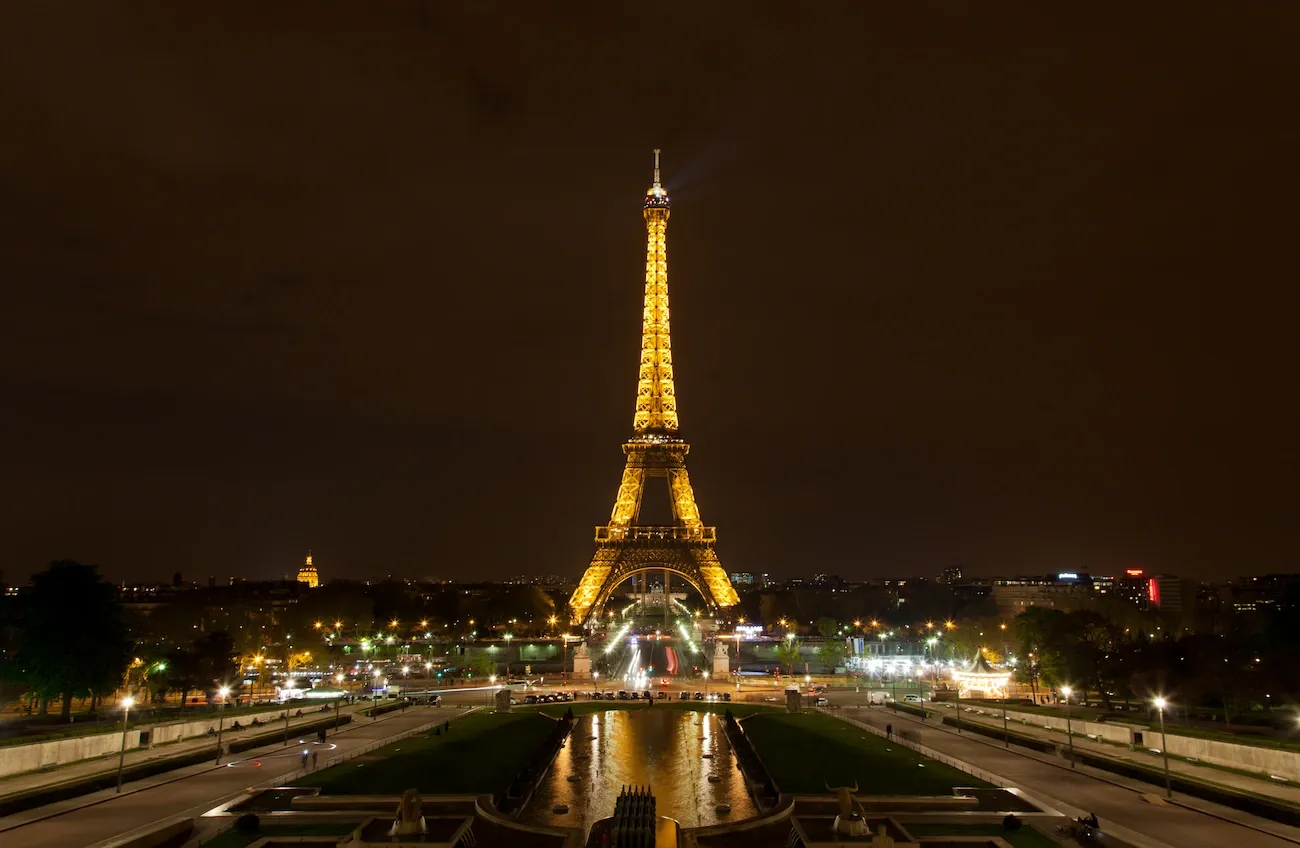
What the tower looks like after sunset?
After dusk the tower runs three lighting modes that together create the night-time silhouette photographers and visitors recognise: the golden illumination, the rotating beacon (phare) at the top, and the hourly sparkle (scintillement).
At the start of every hour after nightfall, a separate set of bulbs flashes for five minutes on all four faces of the tower, and the iron lattice looks studded with cold fireworks while the golden glow continues underneath. A dedicated page explains the full light show, which covers the projectors, bulb counts, and the changes the tower has gone through since 1985, while the hourly sparkle schedule tracks the start time month by month.
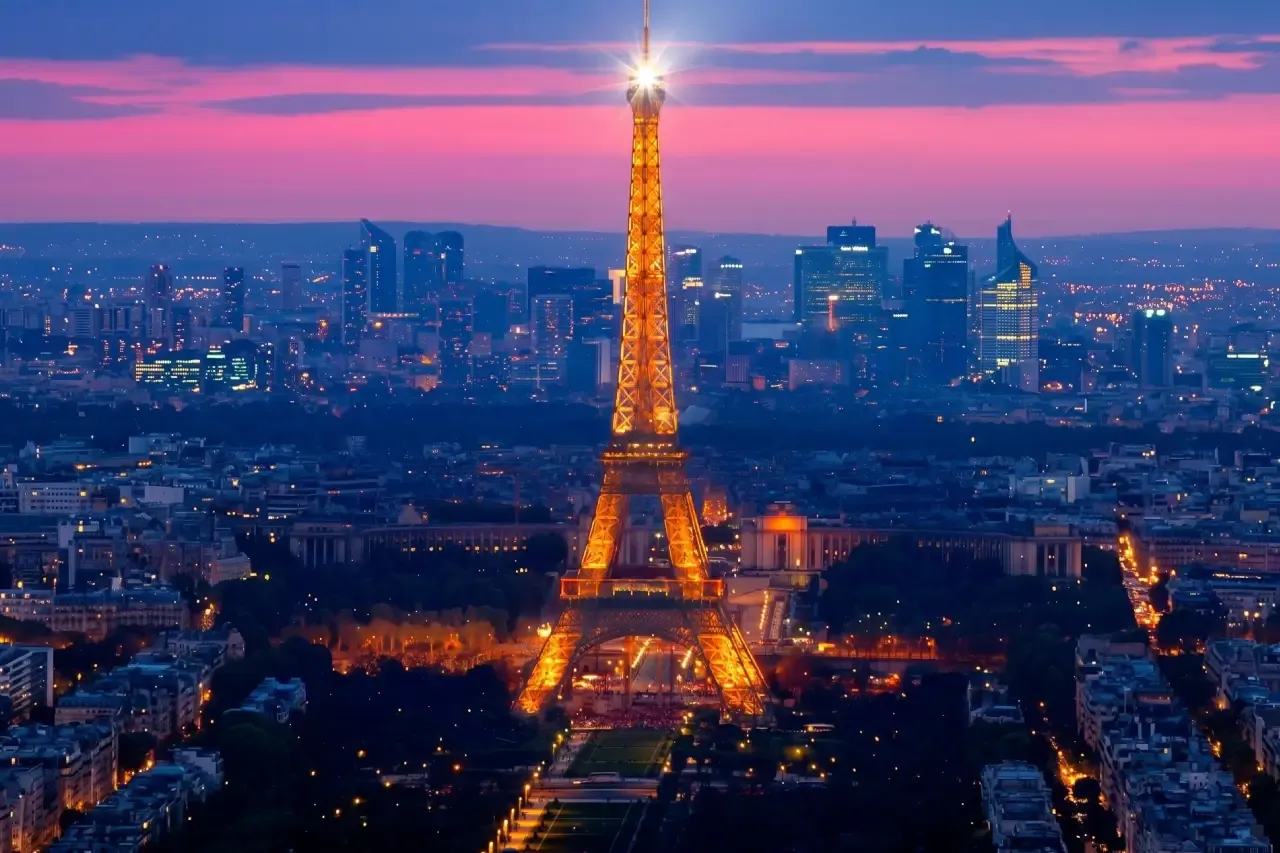
Where are the best places to watch the tower at night?
Three vantage points anchor every credible list of where to see the Eiffel Tower at night: Place du Trocadéro for the head-on panorama from the Right Bank, the Pont de Bir-Hakeim for the side-on framing where the steel-and-stone bridge crosses the Seine in line with the tower's lattice, and the Champ de Mars for the look-straight-up perspective. Two more spots widen the angle and the altitude. Pont d'Iéna links the Trocadéro to the Champ de Mars, while Avenue de New York runs along the Right Bank quayside with reflections off the water. For a different scale, the Tour Montparnasse rooftop and the steps of the Sacré-Cœur basilica in Montmartre frame the tower inside a wider city panorama. The table below compares the six external vantages plus the on-tower option. The longer page on evening viewpoints around Paris covers the full set with photographer-grade angle notes and seasonal timing.
Dining at the Eiffel Tower in the evening
The tower hosts three evening venues across its three floors, each running a different style of service: a contemporary brasserie, a Michelin-starred dining room, and a champagne bar at altitude. Reservations sit at the centre of every option except the lightest snacks.
Madame Brasserie, the first-floor restaurant at 57 m, is led by Chef Thierry Marx and runs a Parisian brasserie menu built around Île-de-France produce and short supply chains. The dining room looks out toward the Trocadéro and the Pont d'Iéna, dinner sittings typically split across an early and a late service in the evening, and advance booking matters on weekends and during the summer extension, when the late sitting overlaps with the final sparkles of the night.
Le Jules Verne, the second-floor restaurant at 116 m, holds two Michelin stars under Chef Frédéric Anton (the first awarded in 2020, the second in the 2024 guide) and is reached by a private elevator separate from the public visitor lifts. The restaurant takes reservations through its own booking channel, and the timed-slot ascent ticket does not stand in for a table, so visitors need to arrange the two separately. The dining room's elevation puts the city panorama through the windows, and the meal runs across a multi-course tasting structure.
The champagne bar at the top sits on the 276 m visitor platform and is the closest way to be at altitude while the sparkle fires. The bar runs without a booking subject to availability across the evening. For lighter evening options, the 1st floor and 2nd floor buffets serve quick snacks, the Macaron Bar on the 2nd floor handles a sweet stop, and the esplanade takeaways stay open during operating hours.
Is it safe at the Eiffel Tower at night?
The area around the Eiffel Tower is safe in the evening, and the realistic concern for visitors is pickpocketing rather than violent crime. The crowds that gather at the Trocadéro and along the Champ de Mars during sparkle moments produce the dense, distracted, phone-in-hand environment that opportunistic theft exploits, so keeping bags closed and wallets in front pockets matters more here than the general Paris baseline. Tourist-pickpocketing surveys list the Eiffel Tower vicinity among the more active hotspots in Europe, but the response is straightforward situational awareness rather than avoidance.
The Bir-Hakeim metro stop stays busy and well-lit during evening hours, with regular foot traffic from visitors heading back across Paris until the last train. Bag and parcel checks may be in place at the tower entrance, and pets and large luggage are not allowed inside, so planning around those rules removes the most common friction points at security. After the 23:45 lights-off the deep lawn of the Champ de Mars empties of casual visitors and grows quieter, so sticking to the lit footprint and the lines of foot traffic is the sensible default rather than crossing the park diagonally. Returning by metro rather than walking solo along the Seine late at night is the lower-risk choice for visitors travelling alone.
Photographing the Eiffel Tower at night
Personal photographs of the lit Eiffel Tower are fine for tourists and for sharing on social media, and the question only sharpens when those images move into commercial publication. The tower itself entered the public domain in 1993, seventy years after Gustave Eiffel's death, which means the day-time silhouette can be reproduced freely. The night-time lighting installation is a different work. A French court ruled in June 1990 that a special 1989 lighting display was an "original visual creation" protected by copyright, and the Court of Cassation upheld that ruling in March 1992. Since then, the Société d'Exploitation de la Tour Eiffel (SETE) has treated any illumination of the tower as a separate copyrighted work, so commercial publication of a night photograph in France needs permission. No one enforces against tourist snapshots; the rule bites for posters, stock-image sales, packaging, and other commercial reuse.